MCP in Practice: Why the AI Integration Layer Is Standardizing Fast

AI projects rarely stay small for long.
One team builds an assistant. Another wants an internal ops bot. Then support wants AI access to tickets and knowledge bases. Then product wants AI features inside the customer experience.
That is when the integration problem stops being a side issue and starts becoming the real work.
Suddenly, multiple AI tools all need access to the same systems: documentation, repositories, tickets, data, deployments, customer records, and internal workflows. Without a shared approach, teams end up rebuilding the same connectors, permissions, logging, and security reviews over and over.
That is a big reason MCP, or Model Context Protocol, is spreading so quickly. It gives companies a more consistent way for AI applications to connect to tools and data.
The important point is this: MCP does not replace your APIs. It standardizes how AI systems use them.
For businesses moving beyond a single AI demo, that is a meaningful shift.
The real problem MCP is solving
A lot of the discussion around MCP makes it sound like a replacement for existing architecture.
It is not.
Your APIs still do the core work. They still power your services, business logic, and internal systems. What MCP helps standardize is the AI-facing layer: how an AI application discovers capabilities, accesses context, and calls actions in a more reusable way.
That matters because the integration burden grows faster than most teams expect.
A single AI assistant connected to a few systems might be manageable. But once multiple AI hosts need access to multiple business tools, the same integration work starts multiplying fast.
And the cost is not just engineering time.
It is also duplicated auth logic, duplicated permissions work, duplicated retries, duplicated logs, duplicated reviews, and duplicated maintenance. That is where the drag starts to show up.
Why this gets expensive fast
The pain is easy to underestimate because it often arrives one successful pilot at a time.
A company builds one useful AI workflow. Then another. Then another. Each one looks reasonable on its own. Together, they create a growing layer of custom glue code that becomes harder to manage, secure, and extend.
What started as speed turns into inconsistency.
That is why MCP is getting attention. It helps reduce the cost of repeating the same integration patterns across different AI tools and teams.
In practice, the value is not novelty. The value is reuse.
What MCP standardizes, in plain English
The simplest way to think about MCP is this:
Your systems keep their existing interfaces, and MCP gives AI applications a common way to interact with them.
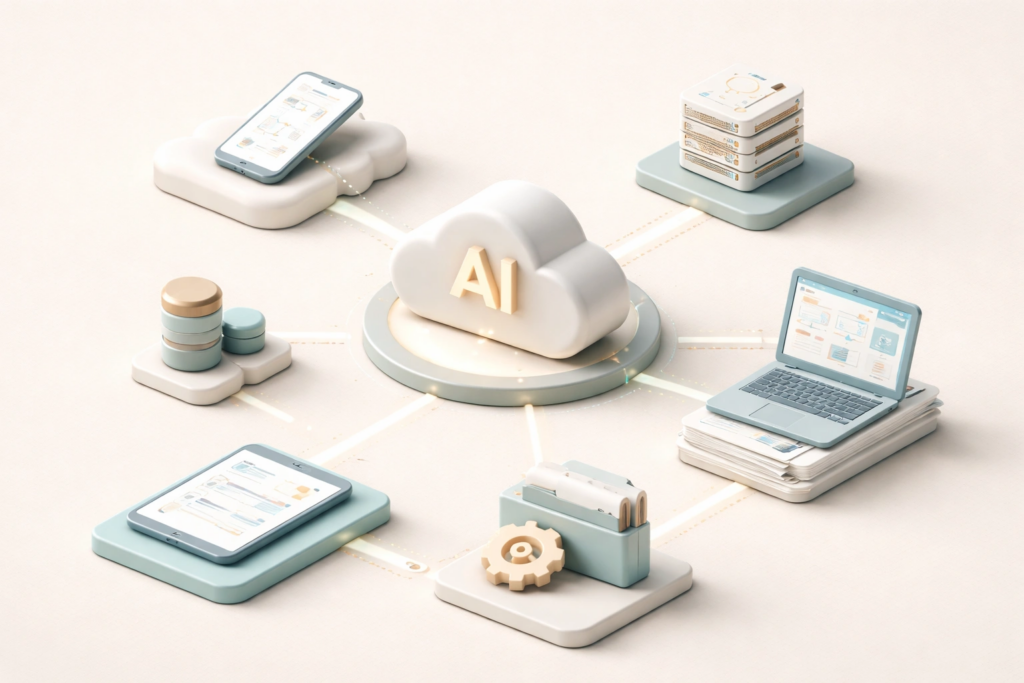
Instead of each AI host inventing its own connector behavior, MCP creates a shared contract for exposing tools, context, and actions.
That is why the phrase “AI integration layer” is useful here.
It is not a new replacement for the systems underneath. It is a cleaner way to connect AI to the systems you already have.
Where businesses are most likely to feel the value
The first benefit is usually not better model output.
It is less duplicated integration work.
Imagine a company that wants an internal support assistant, an engineering copilot, an operations bot, and a customer-facing AI workflow. If all of them need controlled access to tools like Jira, GitHub, internal docs, incident systems, or customer data, building those connections separately gets expensive fast.
A more standardized layer makes it easier to expose those capabilities once, reuse them across multiple hosts, and apply more consistent controls.
That does not mean every company needs MCP right away. But once AI adoption starts spreading across teams, products, or internal workflows, standardization becomes much more compelling.
Why governance matters as much as reuse
Standardization is useful. Standardized access without clear control is not.
As soon as multiple AI systems start sharing an integration layer, governance becomes part of the architecture. Businesses need to think clearly about what each host can access, how permissions are scoped, how actions are logged, and how exceptions are handled.
That is why the integration layer is not just a developer convenience. It is also a control surface.
Done well, it gives teams a more consistent way to manage access and oversight as adoption grows. Done poorly, it can simply make messy access patterns easier to spread.

Where teams usually get it wrong
A common mistake is trying to standardize everything at once.
That often turns MCP into a broad migration effort instead of a practical improvement.
The better approach is usually much narrower. Start where duplication already hurts. Start with tools that multiple AI workflows already need. Start where reuse, policy, and logging matter enough to create immediate value.
In other words, do not begin with theory. Begin with drag.
That is what keeps the effort grounded in real business gains instead of turning it into infrastructure for infrastructure’s sake.
How to approach it realistically
For most businesses, the smartest rollout is simple.
Pick a small number of high-value integrations. Reuse them across more than one AI host. Add ownership, policy, and logging early. Expand only after the pattern proves useful.
That approach tends to produce the outcomes that actually matter:
- Less repeated connector work
- Faster onboarding for new AI workflows
- Better consistency across teams
- Clearer governance boundaries
- Lower maintenance overhead over time
This is also where custom development often becomes important. The challenge is rarely just implementing a protocol. It is fitting that protocol into existing systems, security requirements, internal workflows, and operating realities.

Final thoughts
MCP is gaining traction for a practical reason: it helps clean up one of the messiest parts of real-world AI adoption.
Not the model itself. The layer around it.
As companies move from isolated pilots to multiple production AI workflows, that layer starts to matter very quickly. The teams that standardize it well can move faster, reuse more, and govern access more consistently.
The key is to keep the mental model clear. MCP is not replacing your APIs. It is making them easier for AI systems to use in a repeatable, controlled way.
That is why this trend matters. And that is why the AI integration layer is starting to look a lot less like plumbing and a lot more like infrastructure.
FAQ
Why are more teams talking about MCP instead of building more AI tools one by one?
Because the problem usually stops being the AI tools themselves. It becomes the repeated integration work around them. MCP helps reduce that duplication.
Does MCP replace APIs in an ai-driven financial workflow or other business systems?
No. Your APIs still do the core work. MCP helps standardize how AI agents and AI tools connect to those systems in a more reusable way.
Is MCP mainly useful for large AI experimentations?
Not necessarily. It becomes useful when multiple AI experimentations start creating the same integration drag. That can happen earlier than many teams expect.
What is the main business value of MCP for financial automation or other internal workflows?
The main value is reuse. A more standardized layer can lower repeated connector work, improve consistency, and make governance easier as more AI-driven workflows are added.
What is the safest way to roll out MCP with AI agents?
Start small. Pick a few high-value integrations, reuse them across more than one host, and add policy, ownership, and logging early. That is usually a better approach than trying to standardize everything at once.
Exploring AI Integration Architecture?
If your team is evaluating where AI integration standardization could create real value, the hard part is usually not understanding the protocol itself. It is deciding where standardization will actually help, how it should fit your existing systems, and what controls need to be in place as adoption expands.
We help companies assess opportunities like these, design practical rollout paths, and build custom software solutions around real operational requirements.